The Goods
Suckerpunch Mech Gunner brought the action of the big screen to the clunky, under-powered 9.7” display of the first generation iPad.
My Roles
Creative Director
Gameplay and Level Designer
Production: Environments, Animation & Textures
The Brief
To increase buzz in support of the release of SuckerPunch, a major motion picture from Warner Brothers, Mondo Robot was asked to create a realtime 3D game for the iPad.

Our goal - to express the atmosphere and feel of the film in order to provoke curiousity about the creative world of the film and to drum up interest on the release - ultimately by creating an engaging,  immersive, app-store-ready game.
The Problem(s)
A Barely Tested Platform
The iPad was a new device and touchscreen 3D games of this scale were only just beginning to happen.

With only months before the film’s release, we would have to not only design and launch an app-store ready game, we’d also need to build a POC to prove to Warner Brothers (and ourselves) that it was even possible.
Not much to follow
The film was yet unreleased and highly secretive. Our background on the film consisted of flying out to LA and being shown a 5 minute sequence on the Avid.
Understanding the Platform
The first generation iPad, for all of its glory, had not been on the market for very long. There were very few examples to follow for touchscreen based games, and the ones that existed tended around more "on-rails" and shooting gallery experiences.

It was somewhat against our better judgement to approach this as a first-person-shooter, but we wanted to focus on the discoverability of the world and the atmosphere it lived in.
Primary of the problems was how players would control their mech? With very few examples to follow, we knew that iteration and play-testing were going to be one of our greatest allies.

Initial fears that a smooth touchscreen with no homing would fail, but in the end it tested well with our small testing audience. It's no Call of Duty, but the controls would ultimately be intuitive enough for all of our playtesters to easily navigate and engage with the challenges of the game.
Multi-touch Control Scheme
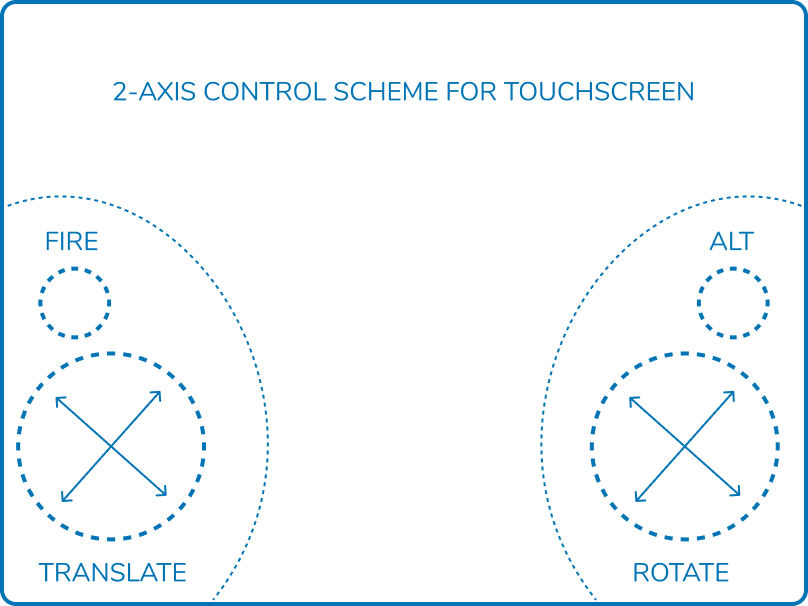
We opted for a 2 zone control scheme, mapping the typical left-hand translate / right hand rotate arrangement that is common in desktop games.

Through this arrangement, firing the primary weapon could be coordinated with precise aiming while secondary actions could be triggered while running and evading enemies.
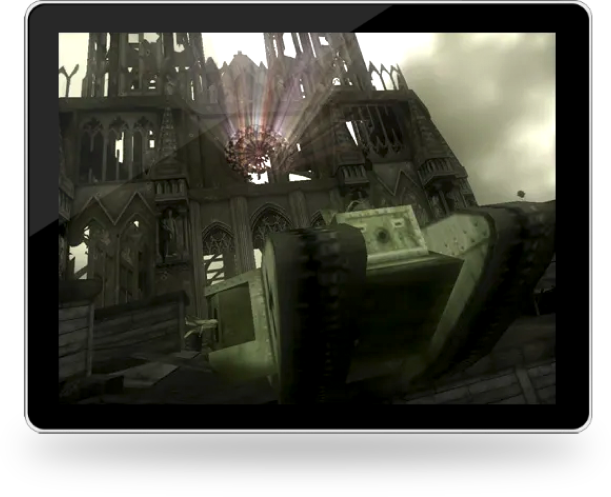
3 worlds that challenge users across a series of tortured battlefields
Interestingly, there wasn't a lot of guidance from the filmmakers in regards to the story they wanted to have unfold in the game. Looking at the business requirements, really we knew that the primary need for this (above even fun gameplay and playability) was to build interest through the world of the film, while leaving the details a mystery.
To this end, we maintained a primary focus on rich environments - grungy, noisy, smoky, hazy dangerous. To draw players through this world, we led them on an adventure through 3 distinct play arenas focusing on up-close and dangerous trench warfare, the claustrophobic confines of a maze of ruins, and an airborne chapter where the skies abound with threats.
Trench Warfare
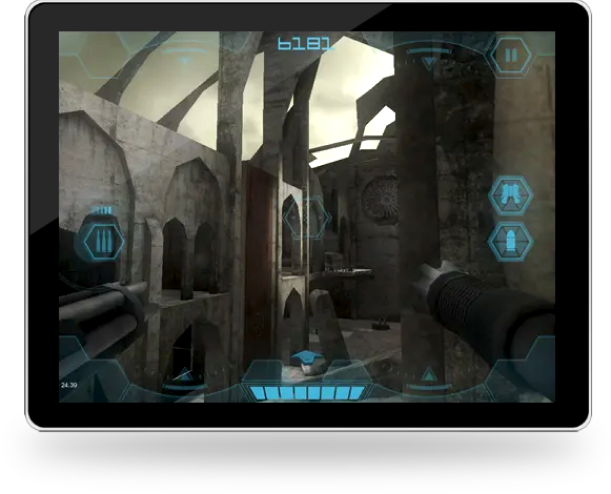
Navigating perilous trenches where enemy soldiers await you at every turn, players make their way to the crumbling cathedral, where they are greeted face-to-face with a barrage of artillery from a heavily armored tank.
Roaming the Ruins
Players wind through the ruins of a demolished gothic cathedral as streams of enemy fire rain on them from every dark shadow.
Taking to the Sky
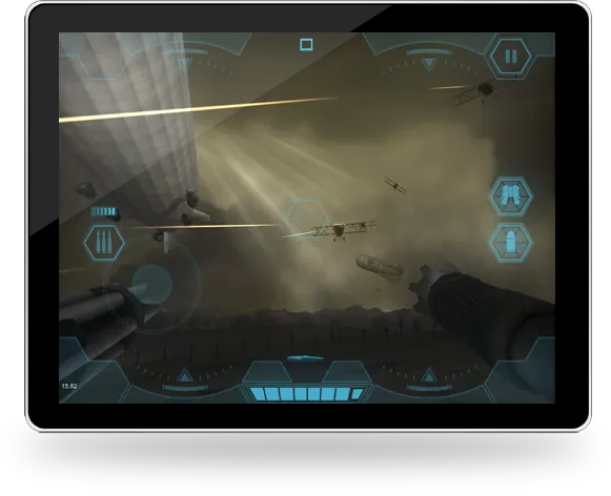
Players fire up their jet packs and take to the air as they’re assaulted by buzzing biplanes and a heavily fortified zeppelin.
Constructing an immersive world on a budget
Unity 3D is absolutely one of my favorite pieces of software - with smart, intuitive tools for bring imaginative ideas truly to life. In the contemporary age of powerful computers and dedicated graphics hardware, it’s easy to arrive at beautiful works that easily meet the processing requirements of simple games.

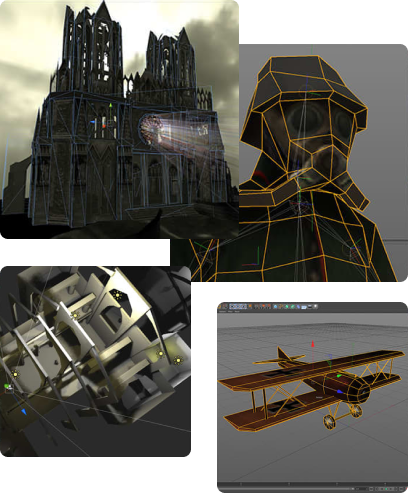
But this was 2011, and the iPad, as interesting as it was, was not an ideal platform for realtime 3D. Additionally, Unity’s tools for lightening the load had not yet matured. Every polygon mattered, textures were baked whenever possible, and 2.5D billboarded geometry often gave more bang for the buck over complex geometry.

Atmosphere took the center stage, but achieving a layered sense of depth within limited rendering capabilities meant finding clever ways of combining 3D geometry, raster billboards and lightweight skydomes while tactfully managing to "hide the seams" of our build approaches.
And in the end we pulled it off.
So, it was not by any measure a grand statement in the world of games, tablets or even simply promotional games... but in the end we created a stable, useful and meaningful product that was deemed valuable to the business, all with a scrappy little team that loved the challenge of pulling it off.
Results
#7 on the iPad App Store for Free Games.

Denver Art Directors Club award in the category of Interactive Design.
Some closing thoughts
With this kind of project, pragmatism rules. Finding the right solution is about focusing on the business value, being realistic about your production footprint, deciding what you want out of it, and paying attention to your team to understand what they want to give for it.